
 By
By The SAT Writing test will challenge your revising and editing skills in thirty-five questions about short passages. These passages cover topics related to careers, science, humanities, and history, and you will be asked to strengthen sentences and paragraphs within these passages. Some questions will ask you to improve the argument of the passage by rearranging or removing phrases and sentences. Other questions will require you to apply particular English grammar rules and knowledge.
In preparing for the SAT writing test, you should plan to study rules related to colons, semicolons, apostrophes, and dashes. You should also spend some time studying idioms. Idioms are unique because they are not governed by any grammar rules like semicolons or apostrophes. However, like other grammar questions on the SAT writing, questions about idioms can be answered quickly if you spend just a few minutes studying them. If you memorize the most common SAT idioms, you will likely have more time to spend on more complex writing questions.
Kickstart Your SAT Prep with Test Geek’s Free SAT Study Guide.
What are idioms?
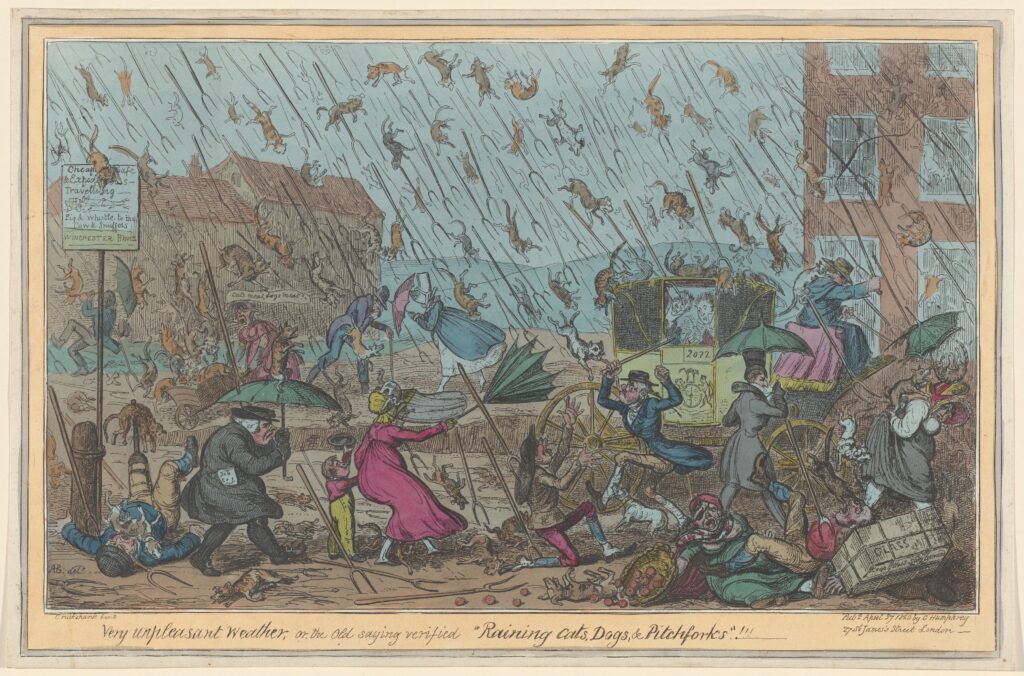
You may know idioms as phrases that do not make sense literally but are commonly used by fluent speakers of English to express ideas. For example, “it’s raining cats and dogs” in English can express the idea that it’s raining very hard.
These are not the kind of idioms that are tested on the SAT. Instead, idioms on the SAT are phrases known as prepositional idioms, infinitive idioms, and gerund idioms. See the full list of prepositional, infinitive, and gerund idioms at the end of this blog.
Prepositional Idioms
Prepositional idioms refer to the standard practice of using one particular preposition with certain words and phrases, and other prepositions with other words and phrases. Prepositions are connecting words that indicate position (to, for, in, on, at, about, by, with). As mentioned above, there are no rules that govern why certain words take certain prepositions, while other words and phrases take different prepositions. These pairings simply must be memorized.
CORRECT: The children were fascinated by the entertaining story.
INCORRECT: The children were fascinated with the entertaining story.
There is no rule indicating that the preposition “by” should be used with the verb “fascinated” rather than “with” or any other preposition. These prepositional idioms become recognizable, primarily, through reading and speaking in English.
Infinitive Idioms
Infinitive idioms refer to verbs that are always followed by another verb in its infinitive form. The infinitive forms of verbs are the “to form,” such as “to eat,” “to read,” “to be,” etc. Some verbs should be followed by other verbs in their infinitive forms.
CORRECT: Molly agreed to sort the beads.
INCORRECT: Molly agreed to sorting the beads.
CORRECT: Sally attempted to outpace her competitors.
INCORRECT: Sally attempted outpacing her competitors. Both of these examples pair verbs that require infinitive verb forms to follow them. It is not correct to have gerunds (“sorting” and “outpacing”) following these verbs.
Gerund Idioms
Gerund Idioms: Finally, some verbs are always followed by gerunds. Gerunds are verbs that function as nouns and usually end in “ing.” In the example, “I like running and swimming,” running and swimming are gerunds—verbs that in this sentence are acting as nouns. Running and swimming are the direct objects of the verb “like.” What do I like? Running and swimming.
CORRECT: His accomplice accused him of cooperating with law enforcement.
INCORRECT: His accomplice accused him of cooperated with law enforcement.
The verb accused (and other verbs in the full list below) do not always need to be followed by verbs. But, if they are followed by verbs, they must be verbs in the gerund form.
CORRECT: The accomplice confessed to driving the getaway car.
INCORRECT: The accomplice confessed to drove the getaway car.
The verb confessed, when followed by a verb, should be followed by a verb in the gerund form.
Similar to understanding idioms like “it’s raining cats and dogs,” native English speakers will likely not have any problems answering prepositional idiom questions on the SAT. Errors in prepositional idioms “sound wrong” to native English speakers.
Feeling Overwhelmed? Get 1-on-1 SAT Help from a Test Geek Tutor.
Those who learned English as a second language do not have this advantage, however, and may find it helpful to familiarize themselves with a list of common prepositional idioms in English.
Remember, questions on the SAT won’t be labeled, but questions about short phrases that include prepositions, gerunds, or infinitives are likely idiom questions. Keep an eye out for those questions and spend a few minutes looking over the list below, and you’ll be confident when approaching idioms on the SAT!

Common SAT Idioms
Prepositional Idioms
Prepositional Idioms with “about”
These words might be incorrectly used with “on” or “to” (incorrect: ask on, talk on, bring to).
- Anxious about
- Ask about
- Bring about (meaning cause to happen)
- Curious about
- Hear about
- Think about
- Talk about
- Worry about
Prepositional Idioms with “as”
These words might be incorrectly used with “to” or “to be” (incorrect: perceived to be the most important”).
- Perceive as
- Regard as
- See as
- View as
Prepositional Idioms with “at”
These words might be incorrectly used with “to” (incorrect: “she is adept to handle this sticky situation”).
- Adept at
- Aim at
- Arrive at
This prepositional idiom is different from the prepositional idiom “arrive in.” Arrive at should be used for specific locations (I arrived at Penn Station in lower Manhattan). Arrive in is used for general locations (I arrived in New York at 10 am).
- Look at
- Succeed at
- At the end
This prepositional idiom is different from the prepositional idiom “in the end.” At the end should be used for indicating conclusions or physical edges (I am at the end of my rope). In the end should be used as in “in conclusion” (In the end, her SAT score increased threefold).
- At fault
- At hand
- At last
Prepositional Idioms with “by”
These words might be incorrectly used with “with” (incorrect: “amazed with his achievements” and “impressed with her classmates”).
- Accompanied by
- Amazed by
- Confused by
- Fascinated by
- Followed by
- Impressed by
- Struck by
Prepositional Idioms with “for”
These words might be incorrectly used with “as” (incorrect: “she could be mistaken as her sister”).
Meant for
Mistake for
Necessary for
Responsible for
For certain
Prepositional Idioms with “from”
These words might be incorrectly used with “in” or “than” (incorrect: “she has been absent in school for several days” and “apples are different than oranges”).
- Absent from
- Abstain from
- Different from
- Excuse from
- Far from
- Protect from
Prepositional Idioms with “into” and “in”
- Enter into
- Look into
- Inquire into
- In advance
- In brief
- In bulk
- In danger
- In debt
- In demand
- In fact
- In general
- In a minute
- In particular
- In reality
- Engage in
- Interested in
- Succeed in
Prepositional Idioms with “on”
- Base on
- Focus on
- Impose on
- Prey on
- Rely on
- On average
- On display
- On fire
- On hand
- On the other hand
- On purpose
- On sale
- On schedule
Prepositional Idioms with “of”
- Approve of
- Capable of
- Certain of
- Characteristic of
- Combination of
- Deprive of
- Die of
- A fan of
- In danger of
- In recognition of
- A model of
- Remind of
- A selection of
- Suspicious of
- Take advantage of
Prepositional Idioms with “to”
These words might be incorrectly used with “with” (incorrect: “it’s acceptable with your family but not your friends”).
- Able to
- Acceptable to
- Accustomed to
- Adapt to
- Adhere to
- Admit to
- Adjacent to
- Agree to
Agree to is different from agree with. Agree to indicates permission (My mom agreed to a later bedtime). Agree on indicates sharing an opinion (They agreed on politics and religion).
- As opposed to
- Belong to
- Central to
- Contrary to
- Contribute to
- Essential to
- In addition to
- In contrast to
- Listen to
- Object to
- Prefer to
- Partial to
- Reply to
- A threat to
- Try to
- Unique to
Prepositional Idioms with “with”
- Acquainted with
- Associated with
- Bargain with
- Consistent with
- Correlate with
- Familiar with
- Identify with
- In keeping with
- Interfere with
- Sympathize with
- Trust with
Verbs Followed by Infinitives
- Agree
- Attempt
- Choose
- Condescend
- Dare
- Decide
- Deserve
- Encourage
- Expect
- Fail
- Intend
- Love
- Mean
- Neglect
- Offer
- Plan
- Prepare
- Promise
- Refuse
- Seem
- Strive
- Swear
- Tend
- Threaten
- Want
Verbs followed by Gerunds
- Accuse of
- Admire for
- Allow
- Appreciate
- Capable of
- Complete
- Concetrate on
- Confess to
- Conscious of
- Consider
- Delay
- Describe
- Discourage from
- Discuss
- Dislike
- Effective at
- Enjoy
- Escape
- Finish
- Forbid
- Imagine
- Insist on
- Permit
- Plan on
- Postpone
- Refrain from
- Resent
- Resume
- Stop
- Tolerate










Comments