
 By
By Many people have heard of the SAT and the PSAT/NMSQT, but did you know that there’s also a PSAT 10? The PSAT 10 is very similar to the PSAT/NMSQT in content and structure but still exists as its own separate test. In this article, we’ll tell you all about what the PSAT is. You’ll learn how long the PSAT 10 takes, what a good PSAT 10 score is, and who should think about taking the PSAT.
The SAT “Suite of Assessments”

There are four tests that make up the “SAT Suite of Assessments.” Along with the PSAT10, the PSAT/NMSQT, and the SAT, there is also a test designed for younger students called the PSAT 8/9.
These four tests are all very similar to each other. Each test covers the same sections (reading, writing, and math), and asks questions in a similar format. You could imagine the Suite of Assessments as a video game. You’re playing the same game at each level, but playing the game on “expert” is going to be more challenging than if you’re playing at “beginner” or “rookie.”

School districts must administer all three PSAT tests. Usually, the test happens on a Tuesday or Wednesday in place of regular classes. If you’re homeschooled, you can check with your local school district to see when the next PSAT test will take place. They’ll have more information for you about how you can sign up to take the test. Click here to find a testing location near you.
Colleges won’t ask you for your PSAT score. All three PSAT tests primarily exist to help you prepare for the main SAT test, which most students take during their senior year. The different levels of the PSAT allow you to experience what it’s like to take the SAT without overwhelming you with content that’s too difficult.
Your test results can also show you where you need to spend the most time studying and preparing before you take the SAT. Each PSAT will show you “testing benchmarks,” based on how well you do and what grade level you’re in.
The PSAT/NMSQT
The PSAT/NMSQT is given during the fall, often around October. Many school districts require all juniors to take the test. In addition to helping students prepare for the SAT, the PSAT/NMSQT is also an important part of the process of qualifying for a National Merit Scholarship. Visit this link for more information on how to qualify for a National Merit Scholarship.
Some school districts will also administer the PSAT/NMSQT to sophomores. Keep in mind, however, that only test scores from your junior year can qualify you for a National Merit Scholarship.
The PSAT 8/9
The PSAT 8/9 gives students a chance to start preparing early for the SAT. Your score report will show you what kind of progress you’re making in each of the three subject areas (reading, writing, and math). Schools can choose to give the PSAT 8/9 in the fall or spring, but it must occur during a window approved by the College Board.

All About The PSAT 10
Like the PSAT 8/9, the PSAT 10 must happen during a window approved by the College Board, and can only be offered once per district per year. Some districts charge for the PSAT 10, but many will cover the cost.
There are two major differences between the PSAT 10 and the PSAT/NMSQT:
- The PSAT/NMSQT is taken by juniors in the fall, and the PSAT 10 is administered to sophomores in the spring.
- Students cannot qualify for a National Merit Scholarship based on PSAT 10 scores.
Even though you can’t use a PSAT 10 score to qualify for a National Merit Scholarship, there are still several reasons why taking the PSAT 10 is a good use of your time. Keep reading to learn more.
Who Should Take the PSAT 10?
While the PSAT 10 is designed for sophomores, freshmen can also take it and might benefit from doing so. The content won’t be as difficult as the regular PSAT but will be a level above the PSAT 8/9. Some students may want that extra challenge.
On rare occasions, juniors might benefit from taking the PSAT 10, but these situations are uncommon. Examples include a student who is learning English as a second language or a student who has strong deficiencies in one particular subject. If you don’t fall into either of these categories, you might as well take the PSAT/NMSQT and see how you do.
If you’re not sure which test is best for you, reach out to your college admissions counselor or an academic counselor at your high school.
What’s On the PSAT 10?
Like the three other tests from the Suite of Assessments, the PSAT 10 has three sections. We’ll talk more in detail about each section below.
Reading
Structure
On the PSAT 10 reading test, you’ll have 60 minutes to read five passages and answer 47 multiple-choice questions. Each passage is between 500 and 750 words.
The passages always follow a similar pattern. You can expect each of the following:
- One passage will be from a work of fiction (probably not something you’ve heard of before, and usually not something super recent)
- One or two passages from a US founding document (such as the Constitution) or a text in the Great Global Conversation (ex: a speech from Nelson Mandela)
- One passage related to economics, psychology, sociology, or some other social science
- Two passages connected to science (physics, chemistry, biology, or Earth science)
Of the five reading passages, four stand alone as individual passages. The fifth passage consists of two shorter passages designed to be read together. Some passages may also contain tables, graphs, and charts.
Questions
Questions primarily cover three areas or topics:
- The author’s use of evidence – The test wants to see how well you can identify specific elements of the passage and how the author support various claims or conclusions.
- Interpreting words in context – You don’t need to memorize a bunch of definitions ahead of time, but you want to brush up on your ability to find and use context clues to determine a word’s meaning.
- Analysis in history, social studies, and science – You’ll be asked to analyze patterns in the writing and choose the answer that best explains how or why a given piece of data is true.
How is Reading Different on the PSAT 10?
This chart gives you an idea of how the PSAT 10 and PSAT reading sections differ from the SAT reading section.
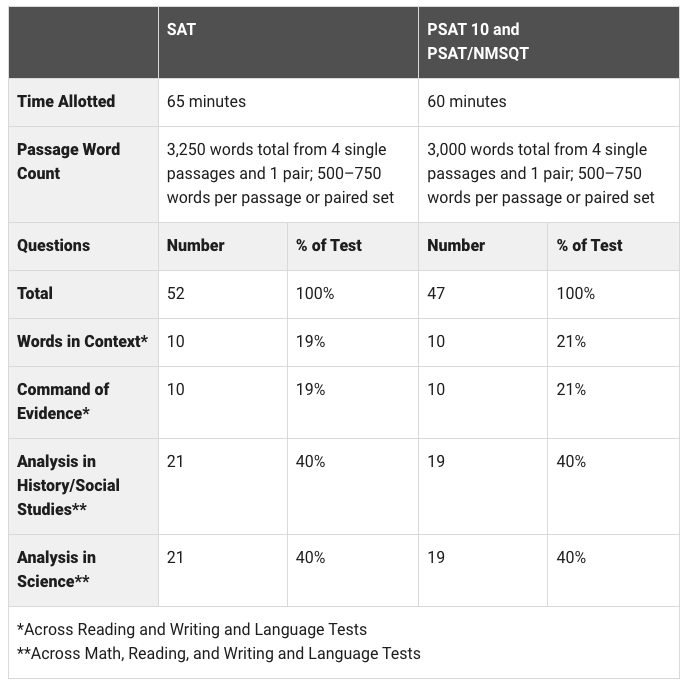
As you can see, most things are similar. The “major” difference is in the number of words read (3,250 on the SAT compared to around 3,000 on PSAT/PSAT 10). There are also fewer questions on the PSAT/NMSQT and the PSAT 10, with less of an emphasis on your sub-scores in Analysis in History/Social Studies or in Analysis in Science.
Writing and Language
Structure
On the writing and language test, you’ll have 35 minutes to answer 44 multiple-choice questions. You won’t actually be doing any writing here. Your task is to eliminate mistakes and weaknesses to help the passage read more clearly and effectively. For example, you might have to identify the best place to add a comma into a sentence.
There are four passages on the writing test. Each passage is between 400 and 450 words long. The complexity and topics will vary from passage to passage. Some passages may be more difficult reads, while others are more easy and straightforward. At least one passage will be “narrative” in style, and the rest will be persuasive or informative.
Questions
You can expect 11 questions about each of the four passages, making 44 questions total. I know, I’m sorry, we’re not in the math section yet, but hopefully, that problem wasn’t too challenging to solve. Questions will fall under one of two categories:
- Expression of Ideas – These are content-related questions. You’ll be asked to improve the author’s communication by combining sentences, eliminating wordiness, or better organizing ideas.
- Standard English Conventions – This is where you’re asked to serve as a proofreader. How well can you catch errors in punctuation, sentence structure, and grammar?
How is Writing Different on the PSAT 10?
Check out this link to see how the PSAT 10 and PSAT/NMSQT Writing and Language test compares to the SAT Writing and Language test. According to this chart, they are….exactly the same. I read through the entire chart twice to make sure I didn’t miss anything. Is this what Creed Bratton felt like on “The Office” when Pam gave him two identical pictures and asked him to find at least seven differences?

Based on what we already know about the PSAT 10, we can infer that the content may be slightly easier than what’s on the more advanced tests, but not a whole lot different. However, this similarity might work to your benefit. Because the tests are so similar, the PSAT 10 writing test will help you prepare in the best way possible for the PSAT/NMSQT and the SAT tests. If you do well on the PSAT 10 Writing and Language test, you will feel especially confident going in for future tests. On the other hand, if it’s challenging or difficult for you, you’ll know exactly what you need to do to prepare for next time.
Math
Structure
The math test is the final section on the PSAT 10 and accounts for half of your final PSAT 10 score. It is broken up into two sections. You will not be allowed to use a calculator on the first part, but you have the option to use an approved calculator on the second math section.
On the no-calculator section, you’ll have 25 minutes to answer 17 questions. Most questions are multiple-choice, just like the first two sections. However, the math section also includes a few grid-in questions. On these questions, you’ll provide a numeric answer that you come up with on your own. After you finish the no-calculator portion, the calculator optional portion of the test will ask you 31 questions in 45 minutes.

Questions
Questions on the math test will fall under four different categories:
- Heart of Algebra Questions – This section tests your ability to solve and analyze linear equations.
- Problem-Solving and Data Analysis Questions – You’ll be tested on how well you can interpret data provided in charts, tables, ratios, and statistics.
- Passport to Advanced Math – This section deals with complex equations.
- Additional Topics in Math – These questions cover geometry and trigonometry.
How is Math Different on the PSAT 10?
The PSAT 10 and PSAT/NMSQT Math test is slightly shorter than the SAT math test, both in terms of time allotted as well as the number of questions asked. The SAT will ask six questions from the “Additional Topics in Math” category, compared to just two of these types of questions on the PSAT 10 and the PSAT/NMSQT. There are also fewer grid-in questions on the PSAT 10 and the PSAT/NMSQT (8) than on the SAT (13). Visit this link for a full breakdown of the differences between the two math tests.
How Long is the PSAT 10?
The entire PSAT 10 test is two hours and 45 minutes long. Here’s a detailed breakdown of the test. You might also be curious to know that you’ll get two five-minute breaks at designated times during the test to stretch, run to the restroom, or take a few deep breaths.
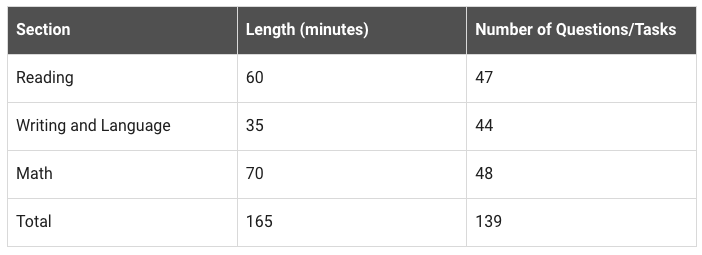
The first five-minute break happens after the reading test and before the writing/language test. The second and final break will take place between the no-calculator portion of the math test and the calculator-optional portion. Altogether, you can expect to devote around three hours to taking the PSAT 10.
What is a Good PSAT 10 Score?
The PSAT 10 and the PSAT/NMSQT use a similar scoring system. Your final composite PSAT 10 score consists of two sub-scores. The first sub-score is a combination of the scores from your Reading and your Writing and Language tests. The second sub-score is a combination of your scores from both math tests. Each sub-score is found by taking your raw score and converting it into a score on a scale between 160 and 760. Both raw scores, added together, make a final composite score between 320 and 1520. Scores are usually available 6-8 weeks after testing.
As for the question about what makes a good PSAT 10 score, it depends on you. Are you taking the test as a sophomore, or are you a freshman looking to get ahead? What’s your motivation for testing? Are you practicing for the SAT or the PSAT/NMSQT? Do you hope to qualify for a National Merit Scholarship at some point? Are you only taking the test because your school district is making you?
The average PSAT 10 score is 920. A score above 1180 would put you within the top 10% of test-takers, and if you score higher than 1360, you’re in the top 1%. On the PSAT/NMSQT, you’ll need a score in the top 1% of all test-takers in your state to qualify for the National Merit Scholarship. So, that 1% number could be one to pay close attention to, although you should also keep in mind that the cut-off will likely be higher on the PSAT/NMSQT. The reason is that junior test-takers have had another year of classroom time under their belt when they take the PSAT/NMSQT.
Why Should I Take The PSAT 10?
You know that the PSAT 10 can’t replace the PSAT/NMSQT, and it can’t qualify you for national merit. So what’s the point of taking it, or getting a good PSAT 10 score? Actually, a lot of good things can come from taking the PSAT 10, and it’s helpful in ways beyond simply helping you prepare for future tests.
Here are four reasons why you should take the PSAT 10:
- The PSAT 10 will help you identify your strengths and weaknesses earlier, so there’s plenty of time to improve before college.
- The PSAT 10 will show you where you most need to study before you take the PSAT/NMSQT or the SAT. For example, if your PSAT 10 score report shows that you had a hard time with “Heart of Algebra” questions on the math section, you’ll have extra time to study those types of questions.
- Your PSAT 10 score report will show you what types of AP classes you might have success taking.
- Anyone who takes the PSAT 10 has the opportunity to opt into the Student Search Service, which connects you with over $300 million in potential scholarship opportunities. Did someone say free money?? Learn more about scholarships here.

How Can I Prepare for the PSAT 10?
So, now that you know what the PSAT 10 is and why it’s important, what can you do to prepare for the test?
Since the PSAT 10 focuses on material that you’re learning in school, the best preparation is to take challenging courses, pay attention in class, and do your homework. If you’re looking for additional resources, you can check out our other helpful in-depth SAT blog posts. You should take a practice PSAT test or two. A practice test will help you imagine what the official test will be like. Many practice tests also come with answer keys, so you can check your work and see where you can improve.
Many students find that working with a tutor makes the process of preparing for a test not only more effective but also more enjoyable. If working with a tutor is something you want to learn more about, reach out to Test Geek today, and we’ll connect you with one of our top SAT tutors.











Comments